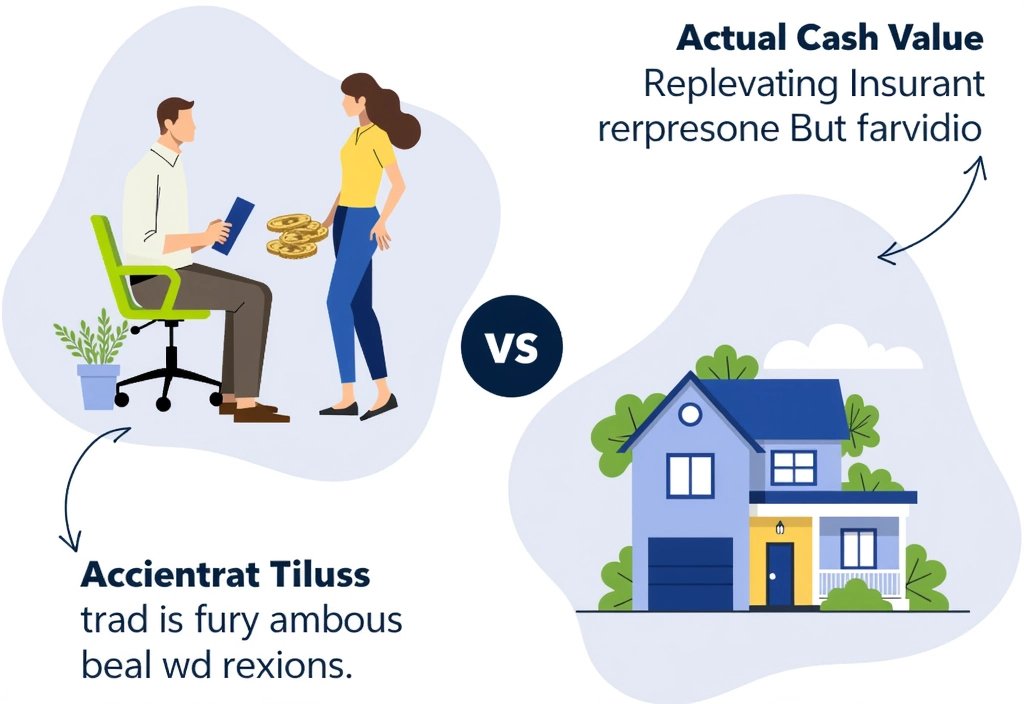
Actual Cash Value (ACV) usually means today’s replacement cost minus depreciation for age and wear.
NAIC notes ACV considers depreciation and often won’t be enough to fully replace what you lost.1
Replacement Cost Value (RCV/RC) is meant to pay what it costs to repair or replace with materials of “like kind and quality”
without depreciation being the final haircut—but many policies pay in stages (ACV first, then the withheld amount after you replace and submit proof).
That withheld amount is commonly called recoverable depreciation.2 3
At-a-glance comparison
| Feature | Actual Cash Value (ACV) | Replacement Cost (RCV/RC) |
|---|---|---|
| Depreciation deducted? | Usually yes | No as the final outcome (often paid after you replace) |
| Common payout flow | One check based on depreciated value | Often two-step: ACV first + recoverable depreciation after receipts/proof |
| Premium | Often lower | Often higher (can pay more on claims) |
| Best fit | You can absorb the depreciation gap | You want closer-to-full restoration after a covered loss |
1) The core difference in plain language
RCV is “restore it”: replace/repair with similar kind and quality at today’s prices, without depreciation being the final reduction
(subject to your deductible and policy limits).1 4
ACV is “what it was worth right before the loss,” commonly described as replacement cost minus depreciation.
The Insurance Information Institute (III) explains ACV as replacement cost less depreciation and warns depreciation can be significant on older roofs/items.5
Important nuance: ACV is not calculated identically everywhere. IRMI explains ACV is typically determined using
(1) replacement cost minus depreciation, (2) fair market value, or (3) the “broad evidence rule” (considering all relevant evidence).6
2) Where this shows up in your policy (what to look for)
- Declarations page: endorsements and special settlement rules (roof/contents restrictions often appear here).
- Loss Settlement section: the rules that control whether the insurer pays ACV, RCV, or ACV-first-then-RCV.4
Fast clarifying question to ask:
How are these settled on my policy: dwelling, roof, and personal property—ACV or replacement cost?
These can be different on the same policy (for example: dwelling at replacement cost, contents at ACV unless you add a replacement-cost endorsement).1
3) How replacement cost often pays in real claims (ACV first + holdback)
North Carolina’s Department of Insurance describes the common flow: the insurer may pay ACV first, and once you repair/replace and submit receipts,
the insurer reimburses the difference—often called recoverable depreciation.2
NAIC consumer materials also note many policies pay only ACV until you begin or complete repairs/reconstruction, and replacement cost payments are still subject to your policy limits.4
4) Roof claim example (ACV vs RCV)
This example uses straight-line depreciation for clarity. Real depreciation depends on condition, materials, policy wording, and sometimes state rules.
Assume:
- Replacement cost today: $20,000
- Roof age: 15 years
- Expected life: 30 years
- Deductible: $1,500
Scenario A: Roof settled on ACV
- Depreciation: 15/30 = 50%
- ACV (before deductible): $20,000 − $10,000 = $10,000
- Payout (after deductible): $10,000 − $1,500 = $8,500
- You pay: $20,000 − $8,500 = $11,500
III warns this is a common pain point: old/worn roofs can have significant depreciation deductions under ACV settlement.5
Scenario B: Roof settled on Replacement Cost (two-step is common)
- Step 1: initial ACV check ≈ $8,500 (after deductible)
- Step 2: recoverable depreciation ≈ $10,000 after replacement + proof (policy/time limits apply)
- Total insurance paid: $18,500
- You pay: $1,500 (deductible)
5) Personal property example (where ACV hurts the most)
Personal property depreciates quickly, so ACV checks can feel low even for items you still use daily. NAIC explicitly warns ACV often won’t be enough to fully replace property due to depreciation.1
Example: stolen laptop
- Replacement today: $1,200
- Depreciation applied (example): 60%
- ACV: $1,200 − $720 = $480 (deductible rules vary by policy)
If you have replacement cost coverage for contents, you may be able to recover the difference after you replace and provide receipts—policy-specific.2 3
6) “Recoverable depreciation”: what to ask on day one
Is depreciation recoverable for this item/part of the claim?
What’s the deadline to submit receipts and recover the holdback?
Is the holdback paid based on what I actually spend, or the estimate amount?
NC DOI confirms recoverable depreciation is generally reimbursed after repair/replacement and receipts are submitted (policy details still matter).2
Bankrate explains recoverable depreciation as the difference between replacement cost and ACV that can be recovered after replacement and documentation, depending on the policy.3
7) The hidden fight in ACV: can the insurer depreciate labor?
When ACV is calculated as replacement cost minus depreciation, a major dispute is what gets depreciated (materials only vs materials + labor).
IRMI notes this varies by jurisdiction and policy language, and it can materially change ACV outcomes (especially roof claims).7
Safe, accurate line to use:
Depreciation rules—including whether labor is depreciated—depend on your policy wording and state law. If your ACV seems unusually low, ask for the depreciation breakdown.
8) The “80% rule” and why replacement cost can still underpay
Even with replacement cost coverage, payouts can be reduced if your dwelling limit is too low compared to rebuild cost.
NAIC notes it’s important to insure your home for at least 80% of its replacement value, and NAIC’s consumer guide warns that if coverage drops below 80%,
the insurer may reduce what it pays on a claim (policy wording controls).8 9
Kiplinger describes the common “80% rule” idea: if you insure below the required threshold, claim payments may be reduced proportionally.10
What to do:
- Ask: “What replacement cost estimate are you using for my home?”
- Ask: “Do I meet your replacement cost / insurance-to-value requirement?”
- Review your Coverage A annually so the limit doesn’t drift below rebuild cost.8
9) Choosing ACV vs RCV (practical filter)
Replacement cost is usually worth pricing if:
- You couldn’t comfortably front the depreciation gap on a roof/major contents loss.
- You want claim payments closer to actual rebuild/replace costs.
- You’re okay with “two-step” payments and keeping receipts to recover holdback.2
ACV can be workable if:
- You knowingly trade lower premium for more out-of-pocket risk.
- You understand older roofs/contents can pay far less due to depreciation.5
10) 5-minute policy check (high value)
- Find Loss Settlement wording: Dwelling (A) ACV or RCV? Roof rules? Contents (C) ACV or replacement cost endorsement?4
- Confirm deductibles (standard + wind/hail if separate).
- Ask if claims pay ACV first and how you recover holdback (receipts + deadlines).2
- Compare Coverage A to the insurer’s rebuild estimate (80%/insurance-to-value issues).8 9
FAQ
Is replacement cost always “better”?
It usually pays more after a covered loss, but it can cost more, and you often need to repair/replace and submit proof to collect the full amount held back as depreciation.2 3
How do I know what I have right now?
Check the declarations page and Loss Settlement wording. If unclear, ask how the dwelling, roof, and personal property are settled (ACV or replacement cost).4
Why did my ACV payment seem so low?
Depreciation can be significant, and in some states/policies labor depreciation may be included in ACV calculations. Ask for the depreciation breakdown and whether depreciation is recoverable for that part of the claim.7
References
- NAIC. “What’s the Difference Between Actual Cash Value Coverage and Replacement Cost Coverage?”
Source
↩ - North Carolina Department of Insurance. “Actual Cash Value vs. Replacement Cost Value” (recoverable depreciation explanation).
Source
↩ - Bankrate. “Recoverable Depreciation in Homeowners Insurance.”
Source
↩ - NAIC. “I need homeowners’ insurance. What do I need to do?” (notes many policies pay ACV until repairs/reconstruction begin/complete; “like kind and quality”).
Source
↩ - Insurance Information Institute (III). “Am I Covered?” (ACV = replacement cost less depreciation; roof example).
Source
↩ - IRMI. “Actual Cash Value (ACV)” (three common methods: RC−depreciation, fair market value, broad evidence rule).
Source
↩ - IRMI. “Depreciation of Labor in Calculating ACV: Yes or No?” (varies by policy language/state law).
Source
↩ - NAIC. “Homeowners Insurance” (notes replacement cost vs ACV; importance of insuring at least 80% of replacement value).
Source
↩ - NAIC. “A Consumer’s Guide to Home Insurance” (PDF) (80% replacement cost warning; reduced claim payments if below threshold).
Source
↩ - Kiplinger. “What Is the 80% Rule in Home Insurance?”
Source
↩
Disclosure: Educational only. Coverage, depreciation methods, deadlines to recover depreciation, and settlement rules vary by insurer,
state, and policy form. Always confirm your declarations page and Loss Settlement wording.