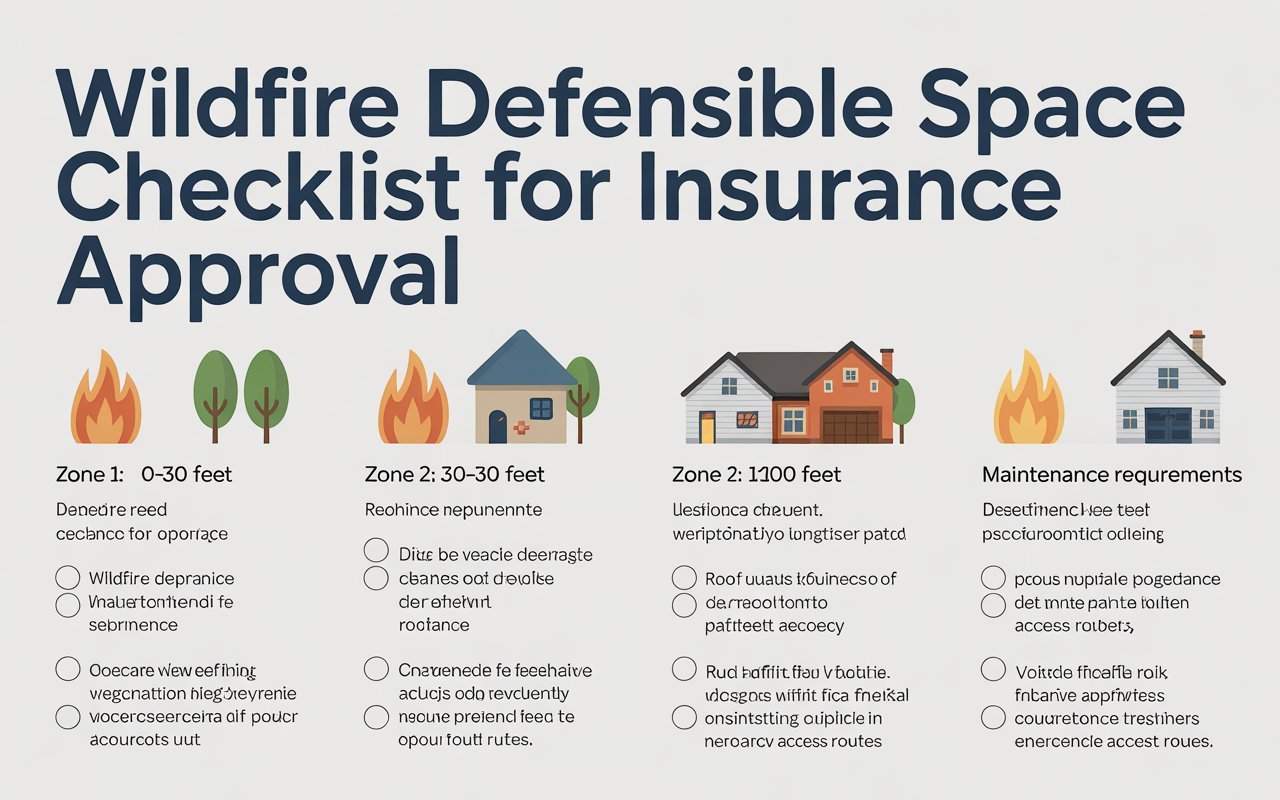
renewing, or repricing a policy. The goal is simple: reduce ignition risk from embers, radiant heat, and surface fire—especially right next to the home.1
California baseline: what’s required vs what’s strongly recommended
- 100 feet (or to the property line) of defensible space is required in applicable areas under California law.2
- California regulations describe two required zones for vegetation management: Zone 1 (0–30 ft) and Zone 2 (30–100 ft) (or to the property line).3
- Zone 0 (0–5 ft) is promoted statewide as the most critical ember-resistant area in CAL FIRE / Ready for Wildfire materials and Board of Forestry resources.4 5
- Statewide Zone 0 rulemaking has faced repeated delays; as of early 2026, timelines and enforcement details can vary—check your local authority for what’s enforced in your jurisdiction.6
Quick “pass-first” list (common inspection fail items)
If you only fix a few things before an inspection, start with the items that most directly reduce ember ignition near the structure.
Zone 0 (0–5 ft): Ember-Resistant Zone
- No wood mulch against the home; use gravel/pavers/concrete where feasible.4
- No shrubs touching siding/windows; nothing stored against walls or under decks.4
- Roof/valleys/gutters clear of leaves/needles/debris (photos help).1
- Firewood/lumber moved away from the 0–5 ft area.4
- Fence-to-house “wick” risk: consider a noncombustible transition where a wood fence attaches to the home (commonly flagged).7
Zone 1 + Zone 2: Break fuel continuity
- Remove dead/dying vegetation; avoid a continuous “fuel path” to the home.4
- Trim trees away from chimneys; reduce canopy crowding and ladder fuels.4
- Clear under decks/balconies/stairs of combustibles and debris.3
- Zone 2 grasses: in applicable areas, annual grasses/forbs are commonly referenced at a max height (often 4 inches) where required.8
- Woodpiles: relocate exposed piles outside Zone 1 unless properly covered (per common guidance tied to regulations).8
Zone 0 (0–5 feet): the ember-resistant zone
This is the area most likely to ignite from wind-blown embers. Board of Forestry / CAL FIRE materials describe Zone 0 as the
first five feet around the structure and emphasize keeping it clear of combustible items like woody mulch and plants.5
Do this (high signal for insurers)
- Replace bark/wood mulch near the foundation with gravel, pavers, or concrete where feasible.4
- Remove dead plants and debris from roof/gutters, decks, porches, stairs, and under-deck areas.1
- Keep combustible storage (bins, lumber, cardboard, spare lumber) away from walls and under decks.
- Move firewood out of Zone 0 (and ideally away from the structure).4
- If a wood fence attaches to the house, consider a noncombustible “break” at the connection point (frequently cited as a problem).7
What inspectors flag constantly
- Wood mulch strip at the foundation
- Shrubs under windows / touching siding
- Leaves packed in gutters/roof valleys
- Storage under decks
Zone 1: Lean, Clean, and Green (first 30 feet)
Regulations describe Zone 1 as extending 30 feet from structures (or to the property line if closer). Many modern guides describe Zone 0 separately as the first 0–5 feet, and treat Zone 1 as the remaining area out to 30 feet where vegetation is kept “lean, clean, and spaced.”3 4
Do this
- Remove dead plants, grass, weeds, and loose debris.4
- Break up continuous fuels; keep space between shrubs/trees and between vegetation and flammable items (furniture, playsets, wood piles).4
- Prune trees away from chimneys and reduce canopy crowding; address ladder fuels (shrubs beneath trees, low limbs into brush).4
- Clear combustibles from under decks, balconies, and stairs (often photographed by vendors).3
Underwriting “photo magnets” (often checked)
- Under-deck storage and debris
- Vegetation touching siding, eaves, or windows
- Chimney clearances
- Wood piles within the first 30 feet
Zone 2 (30–100 feet or to property line): reduce fuel and slow spread
Zone 2 focuses on lowering fire intensity and reducing ladder fuels. Regulation describes Zone 2 as 30–100 feet from structures (not beyond the property line).3
Do this (common measurable items)
- Cut annual grasses/forbs to a manageable height where required (commonly referenced as 4 inches max in applicable guidance tied to regulation).8
- Create horizontal/vertical spacing between shrubs and trees; prune lower limbs to reduce ladder fuels.8
- Avoid litter piles (needles/leaves/twigs) and clear around ignition-sensitive areas.
- Place woodpiles with clearance and away from structures where feasible; follow local guidance on placement and clearance.8
Insurance discount angle (California)
California’s Department of Insurance “Safer from Wildfires” program lists mitigation actions that qualify for insurer discounts,
including a 5-foot ember-resistant zone (including fencing) and other home hardening steps.7
The underwriting documentation pack (fast approval)
Make it easy for an underwriter to approve you without back-and-forth.
1) Photo set (date-stamped)
- 4 wide shots (each side of the home) showing the first 30 feet
- Roofline + gutters (clean, no debris)
- Zone 0 ground cover (show no wood mulch at the wall base)
- Under-deck area (clear)
- Wood pile location (distance + cleared perimeter)
- Outbuildings / propane (if applicable): show clearance and vegetation condition
2) One-page notes
- Address + date
- Bullets of what you changed (example: “Removed mulch within 0–5 ft; cleared gutters; moved firewood; limbed trees; cleared under deck.”)
3) Receipts (optional but helpful)
- Tree work invoices, dump receipts, hardscape delivery, etc.
Pro file naming: 2026-02 Zone0-Gravel-Front.jpg • 2026-02 Gutters-Clean-Back.jpg • 2026-02 UnderDeck-Cleared.jpg
If you “fail” an inspection
- Ask for the inspection photos and reason codes.
- Fix exactly what’s flagged (don’t guess).
- Re-photo from the same angles.
- Resubmit as one clean folder/link plus a short bullet summary.
FAQ
Is defensible space required up to 100 feet in California?
In applicable areas, California law requires defensible space up to 100 feet, not beyond the property line.2
Is Zone 0 (0–5 feet) mandatory statewide?
Zone 0 is promoted statewide as critical ember-resistant guidance. Statewide rulemaking has faced delays, and local rules can differ—verify what is enforced where you live.4 6
What’s the fastest fix that helps the most?
Clean roof/gutters and make the first 5 feet ember-resistant (no wood mulch, no combustibles against the house).1 4
References
- CAL FIRE. “Defensible Space.” Accessed Feb 5, 2026.
Source
↩ - California Legislative Information. Public Resources Code § 4291 (Defensible space up to 100 feet, not beyond property line; see statute text). Accessed Feb 5, 2026.
Source
↩ - California Code of Regulations, Title 14, § 1299.03 (Defensible space requirements; Zone 1 and Zone 2 definitions). Accessed Feb 5, 2026.
Source
↩ - Ready for Wildfire (CAL FIRE). “Defensible Space” (Zone 0, Zone 1, Zone 2 overview). Accessed Feb 5, 2026.
Source
↩ - CAL FIRE / Board of Forestry & Fire Protection. “Frequently Asked Questions about Zone 0” (Sept 17, 2025). Accessed Feb 5, 2026.
Source
↩ - San Francisco Chronicle. “California delays wildfire rules that would force homeowners to clear vegetation” (Zone 0 rule timeline and delays). Accessed Feb 5, 2026.
Source
↩ - California Department of Insurance. “Safer from Wildfires” (discount-qualifying actions including 5-foot ember-resistant zone including fencing). Accessed Feb 5, 2026.
Source
↩ - Ready for Wildfire (CAL FIRE). “Defensible Space and the Law” Factsheet (Jan 2024 revisions). Accessed Feb 5, 2026.
Source
↩ - Board of Forestry & Fire Protection. “Defensible Space Zones – 0, 1, and 2” (project page / ongoing materials). Accessed Feb 5, 2026.
Source
↩ - Executive Order N-18-25 (Zone 0 / defensible space direction and timeline context). Accessed Feb 5, 2026.
Source
↩