When a storm hits your roof, the deductible can be the difference between “annoying” and “ouch.”
Many homeowners don’t realize they may have multiple deductible buckets: a standard deductible (often called AOP or “all other perils”),
plus a separate wind/hail deductible, and sometimes a hurricane/named-storm deductible with special triggers.1
- AOP deductible (All Other Perils): the “standard” deductible for many covered losses; it may be a flat dollar amount (e.g., $1,000) or sometimes a percentage depending on the policy.2
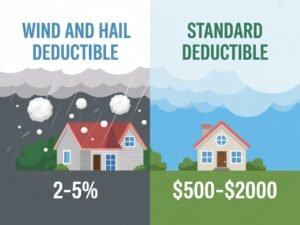
- Wind/Hail deductible: often a percentage of the home’s insured value / dwelling limit (commonly 1%–5%), not a percentage of the repair bill.34
- Named-storm / hurricane deductible: separate from the normal deductible; NAIC notes named-storm deductibles are often 1%–10% and can be a fixed dollar amount in some cases, with rules that may be per event/season/calendar year depending on the policy.4
1) What a deductible is (and what it isn’t)
A deductible is the amount you pay toward a covered loss before the insurer pays its share (it’s subtracted from what the insurer pays).5
It’s not a “fee,” and it doesn’t apply if the loss isn’t covered in the first place.
Example (standard/AOP deductible):
- Deductible: $1,000
- Covered loss: $12,000
- You pay: $1,000
- Insurer pays: $11,000
2) Wind/hail deductible: the part that surprises people
If your declarations page shows Wind/Hail Deductible: 2%, that typically means you pay
2% × your home’s insured value / dwelling limit on a wind/hail claim—not 2% of the repair bill.63
IRMI notes wind/hail deductibles in homeowners policies are often expressed as a percentage of the dwelling limit rather than a flat dollar amount.4
Quick calculator
Wind/Hail deductible (in dollars) = Coverage A (Dwelling) × (percentage ÷ 100)
Example:
- Coverage A: $400,000
- Wind/Hail deductible: 2%
- Deductible = $400,000 × 0.02 = $8,000
What those percentages look like in real money
| Coverage A (Dwelling) | 1% | 2% | 5% |
|---|---|---|---|
| $250,000 | $2,500 | $5,000 | $12,500 |
| $400,000 | $4,000 | $8,000 | $20,000 |
| $600,000 | $6,000 | $12,000 | $30,000 |
Wind deductibles are commonly set around 1%–5% in many markets (varies by state/insurer).7
3) Which deductible applies? (the clean decision rule)
Start here, then confirm with your declarations page and the deductible/endorsement wording.
NAIC notes whether a hurricane/named-storm/windstorm deductible applies depends on the policy’s trigger and contract language (and sometimes state law).8
A) AOP deductible usually applies when the cause is not wind/hail
Common examples: fire, theft, vandalism, and many non-storm losses (depending on policy).
B) Wind/Hail deductible usually applies when wind or hail is the cause of loss
Shingles torn off in a windstorm, hail damage, and other losses your policy defines as wind/hail.
Many insurers use a separate wind/hail deductible in storm-heavy regions.3
C) Named storm / hurricane deductibles can override both
Some policies have a special deductible that applies only when a named storm/hurricane causes damage, separate from the normal deductible.4
NAIC also explains these deductibles are used as a risk-sharing mechanism in hurricane-prone areas and are applied separately from standard perils when triggered.1
On your declarations page, look for lines like:
- “All Other Perils (AOP) Deductible”
- “Wind/Hail Deductible”
- “Hurricane Deductible” or “Named Storm Deductible”
4) Same roof repair, totally different out-of-pocket
Policy:
- Coverage A: $400,000
- AOP deductible: $1,000
- Wind/Hail deductible: 2% (= $8,000)
Claim: Hail causes $12,000 of roof repairs.
Result (if wind/hail deductible applies):
- You pay: $8,000
- Insurer pays: $12,000 − $8,000 = $4,000
5) Variations people miss on the declarations page
Wind/hail can be flat-dollar instead of a percentage
Some policies use a flat amount (e.g., $2,500 wind deductible), while others use a percentage—always verify your declarations page and forms.2
“Percentage of what?” must be confirmed
IRMI notes wind/hail deductibles are often expressed as a percentage of property value or, in homeowners policies, as a percentage of the dwelling limit—don’t guess; verify your policy form and declarations.4
Named storm deductibles can have different “how often it applies” rules
NAIC warns the deductible might be per event, per season, or per calendar year depending on the policy—so you may pay it more than once if multiple storms cause damage.4
6) Why wind/hail (and storm) deductibles tend to be higher
NAIC explains hurricane and named-storm deductibles were introduced as a risk-sharing mechanism to help keep coverage available and premiums more affordable in catastrophe-prone areas; insurers use higher storm deductibles to manage catastrophe exposure.9
7) Check your own policy in 3 minutes
- Open your Declarations page.
- Write down: Coverage A (Dwelling), AOP deductible, Wind/Hail deductible, and any Hurricane/Named-Storm deductible.
- Convert percentage deductibles into dollars: Coverage A × percentage.
- If that number would be hard to pay quickly, plan around it (deductible fund, re-quote options, or shop).
8) Questions to ask your insurer (copy/paste)
- “Is my wind/hail deductible a percentage of Coverage A (dwelling limit) or something else?”6
- “Do I have a named storm/hurricane deductible, and what triggers it?”84
- “Can I choose a lower wind/hail deductible, and how much would the premium change?”
- “Do I have any separate roof/hail endorsements or special roof claim rules listed on my forms?”
FAQ
If I have both, which one applies?
Usually wind/hail applies to wind or hail losses; AOP applies to most other covered perils. Confirm using your declarations page and deductible wording.8
Is a 2% wind/hail deductible always bad?
Not automatically. Higher deductibles generally mean lower premiums, but you’re taking on more out-of-pocket risk when storms hit—make sure you can afford it.4
Can I change deductibles right before a storm?
Often, insurers may impose binding moratoriums when a major disaster is imminent, which can limit new policies and sometimes restrict changes to coverage or deductibles until the threat passes (rules vary by insurer and state).1011
Plan changes ahead of storm season.
References
- NAIC. “Hurricane Deductibles” (storm deductibles applied separately; triggers/contract language; background on risk-sharing).
Source
↩ - The Hanover. “Understanding wind deductibles” (wind deductibles typically range 1%–5% of insured value; standard deductible doesn’t apply to wind claim).
Source
↩ - IRMI. “Wind or hail deductible” (often % of property value; in homeowners, % of dwelling limit).
Source
↩ - NAIC. “What Are Named Storm Deductibles?” (range 1%–10%; can be fixed dollar; may apply per event/season/calendar year; higher deductible/lower premium reminder).
Source
↩ - Insurance Information Institute (III). “Understanding your insurance deductibles” (definition; deductible deducted from claim payment).
Source
↩ - Bankrate. “Insurance Moratorium: What It Is and How It Works” (moratorium may restrict issuing new policies or modifying coverage/deductibles ahead of disasters).
Source
↩ - Orchid Insurance. “Moratoriums” (example moratorium language: changes to coverage limits or deductibles not allowed until lifted).
Source

Home insurance & home-safety writer
Research-focused writer covering homeowners insurance terms, deductibles, endorsements, and loss-prevention basics.
Articles are built from primary insurer/regulator sources and updated when program rules change.