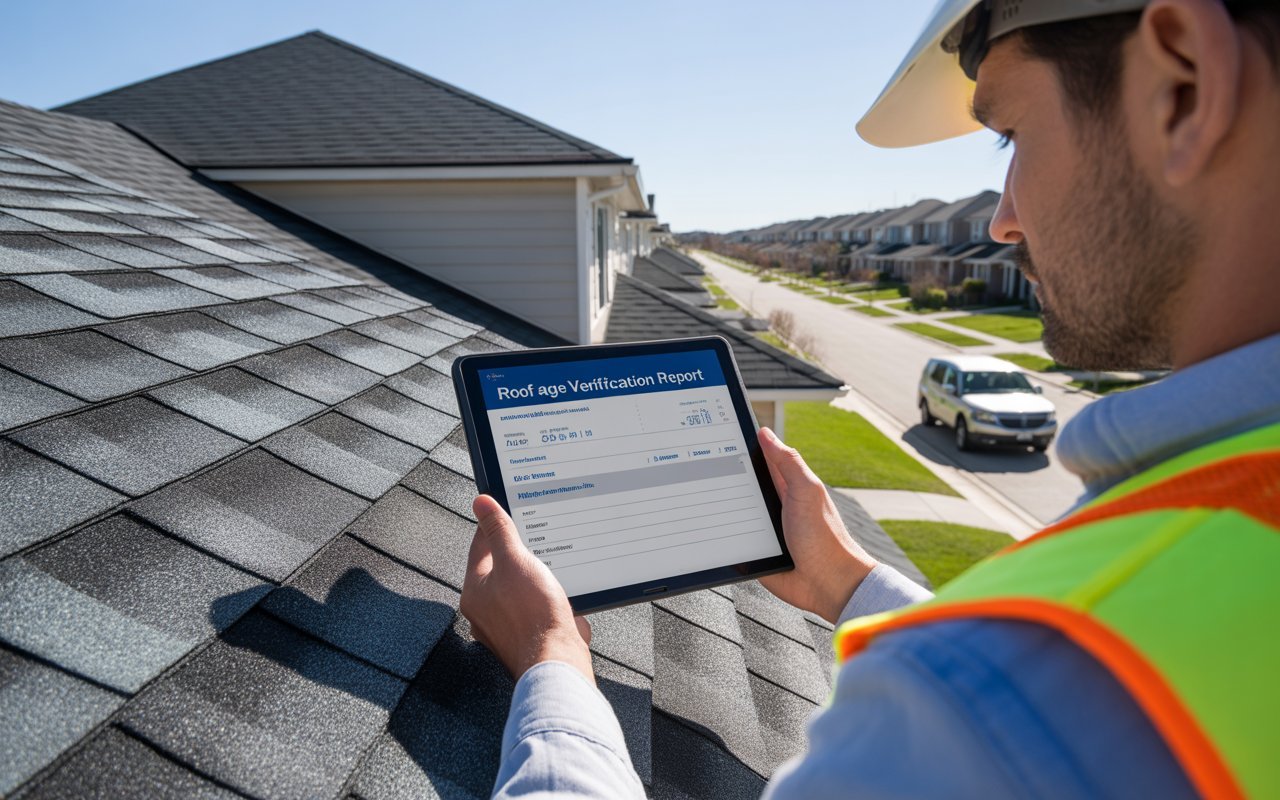
Roof age and roof condition can materially affect home insurance pricing, eligibility, and renewal decisions.
Many insurers verify what you report using third-party property intelligence (including aerial imagery and property/permit-style data),
not only the answers entered in an online quote form.1 2
Quick answer
Build a Roof Proof Pack with:
- Paid invoice/contract for full replacement (best proof)
- Permit + final inspection/close-out (strong proof where permits are issued)
- Roofer/inspector letter stating roof type, estimated age, condition, and remaining life (best fallback)
- Photo set showing roof planes, edges, penetrations, flashing, and any problem areas
- Optional (only if claiming credits): UL 2218 impact class and ASTM wind classification documentation
1) What insurers are trying to verify

Underwriting usually wants four things:
- Replacement date (full replacement date, not a repair)
- Material type (asphalt shingle, metal, tile, modified bitumen, etc.)
- Current condition (visible wear, missing components, repairs/tarping, active leak signs)
- Loss-reduction features (impact-resistant covering, wind classifications, mitigation details)
Why your “year replaced” may get challenged: insurers increasingly use roof-data tools that blend
imagery and property intelligence to estimate roof age and condition and to triage inspections.3 4
2) The Roof Proof Pack (do this once, reuse forever)

Create one folder named:
Roof Proof Pack – [Address]
Add files in this order (strongest to weakest):
A) Full replacement paperwork (best)
- Roofing contract + final invoice showing address, scope (full replacement/tear-off), install date, and material
- Paid proof (paid-in-full line, receipt, or payment confirmation)
Common “weak proof” that often triggers follow-up:
- Seller disclosure/MLS claims with no roofing paperwork
- Estimate/quote with no proof the work was completed
- Photos only with no date context (still helpful, but weaker)
B) Permit record (strong where applicable)
- Roofing permit
- Final inspection/close-out (if issued)
C) Roofer/inspector letter (best fallback if paperwork is missing)
Ask for a 1–2 page letter on letterhead stating:
- Roof type/material
- Estimated replacement year (or estimated age range)
- Condition notes (missing shingles, curling, granule loss, repairs, soft spots)
- Estimated remaining useful life
- Dated photos (embedded or attached)
D) Your photo set (always include)
Even with excellent paperwork, clear photos reduce underwriting back-and-forth—especially when a roof was flagged by imagery.
E) Ratings documentation (optional — only if you’re claiming it)
- UL 2218 impact class documentation (e.g., Class 3 or Class 4)
- ASTM wind classification documentation (keep it as a classification; don’t translate into a guaranteed mph claim)
3) Build the pack in under 30 minutes
- 5 minutes: Create the folder + rename files clearly
- 15 minutes: Take the photo set (checklist below)
- 10 minutes: Export photos, label them, and upload everything
If you’re missing paperwork:
- Do the photo set now
- Get a roofer/inspector letter next (fastest way to create “official” documentation)
4) Roof photo checklist that answers underwriting questions
Safety note: Don’t climb onto a roof for insurance photos. Ground shots, zoom, and a roofer’s photos are fine.
Wide shots (4–6 photos)
- Front elevation showing roofline
- Rear elevation
- Left side
- Right side
- Detached structures with separate roofs (garage/shed)
Close-ups (8–12 photos)
- Shingle field (granules/curling/cracking where visible)
- Ridge and hips
- Valleys
- Flashing around chimney, plumbing vents, skylights
- Drip edge / roof edges
- Any repairs (sealant patches, replaced tabs, exposed nails)
- Any visibly damaged areas
Optional interior support (if you have safe attic access)
- Attic decking: no daylight, no active staining, no sagging
File naming (makes you look organized)
Use a consistent pattern:
2026-02 Roof Wide Front.jpg2026-02 Flashing Chimney Close.jpg2026-02 North Slope Shingle Field.jpg
5) Impact rating (hail): what it means and how to document it
If you’re in a hail-prone area, some insurers ask whether your roof covering is impact-resistant.
UL 2218 is a common impact classification used for roof coverings.
Manufacturer summaries commonly describe Class 4 testing as a steel-ball drop test (2-inch steel ball from 20 feet, often repeated).6 7
Clean documentation options:
- Manufacturer spec sheet showing UL 2218 Class 3 or Class 4
- Contractor letter identifying the exact installed product line
- Photo of packaging label (if you still have it)
Discount reality check: Credits vary by insurer and state—don’t assume. Ask underwriting to confirm eligibility.
6) Wind “rating”: document it without overclaiming
Wind “ratings” are usually test classifications, not a promise your roof will survive a specific storm.
Avoid “my roof is rated for X mph” language unless you’re quoting the exact manufacturer document for the exact product and standard version.
Also note that industry test documentation warns that certain test results do not directly correlate to real-world wind speeds experienced in service.8
Safe wording you can use:
- “Installed shingles are ASTM D7158 Class ___ per the manufacturer product data sheet.”
- “Installed shingles are ASTM D3161 Class ___ per the manufacturer product data sheet.”
7) Florida callout: roof-age protections (current statute) + proposed changes
Florida has a roof-age rule that can matter in underwriting disputes.
Florida Statute 627.7011(5) provides (in summary):
- Insurers may not refuse to issue/renew solely due to roof age if the roof is less than 15 years old.
- If the roof is 15+ years, the homeowner must be allowed to obtain an inspection by an authorized inspector (at the homeowner’s expense),
and the insurer may not refuse solely due to age if the inspection shows 5+ years useful life remaining.
These provisions include definitions for “authorized inspector” and how roof age is calculated.9
Keep this page updated: Florida legislation can change.
For example, Florida SB 808 (2026) proposes revisions to certain property-insurance rules and includes a stated effective date in the bill text/analysis.
Verify the bill’s current status before relying on proposed language.10
8) If an insurer flags your roof using aerial imagery
Insurers use imagery and roof-data tools in underwriting, but disputes happen when imagery suggests “old” condition without proving functional damage.
One clear regulator example: the Connecticut Insurance Department warned that cosmetic roof conditions (like natural discoloration/streaking)
do not support nonrenewal without evidence of material degradation or damage, and it raised concerns about relying on aerial images alone for such actions.
Your response plan (any state):
- Ask for the specific reason code and any photos/imagery relied on
- Send your Roof Proof Pack (invoice/permit + photo set)
- If needed, add a roofer/inspector letter addressing:
- Remaining useful life
- Functional damage vs cosmetic staining
- If the carrier won’t reconsider, shop with the same pack ready to upload
9) Email script to send an agent or underwriter
Subject: Roof documentation for underwriting – [Address]
Roof replacement year (full replacement): ___
Roof type/material: ___
Attached:
- Invoice/permit (if available)
- Roof photo set
- Inspection report/roofer letter (if applicable)
- Impact (UL 2218) and/or wind (ASTM) documentation (only if applicable)
Please confirm this satisfies roof verification for binding/renewal and whether any roof credits apply.
FAQ
Will a roof repair receipt count as proof of replacement?
Usually not. Underwriting typically wants documentation showing a full replacement (scope + date),
or an inspection letter supporting remaining life and condition.
Do I need to prove impact or wind ratings?
Only if you’re claiming them for underwriting questions or credits.
Otherwise, focus first on roof age, material, and current condition.
If my roof is stained, can I be nonrenewed?
Some insurers will flag roofs via imagery. The strongest counter is a Roof Proof Pack plus a roofer/inspector letter
that separates cosmetic staining from functional damage.
References
- Cape Analytics. “The Challenge of Unlocking Accurate Roof Age Data.” (Roof age as underwriting/pricing input; industry roof-age data discussion.)
Source
↩ - Verisk. “Verify the Age of a Roof.” (Describes roof-age assessment using permit insights, aerial imagery, and property data.)
Source
↩ - Carrier Management (Verisk brand spotlight). “A roof can become a window to better commercial property underwriting.” (Roof Underwriting Report: imagery, condition score, estimated age.)
Source
↩ - Verisk (sample document). “Roof Underwriting Report.” (Example of roof imagery/condition scoring data.)
Source
↩ - GAF. “Class 4 Roof Shingles.” (UL 2218 Class 4 steel-ball drop description.)
Source
↩ - Owens Corning. “Class 4, Impact-Resistant Roofing Shingles.” (UL 2218 Class 4 steel-ball drop description.)
Source
↩ - ASTM (D3161). Standard definition page includes cautionary language that results do not directly correlate to wind speeds experienced in service.
Source
↩ - Florida Legislature (Online Sunshine). Florida Statutes § 627.7011(5). (Roof-age underwriting/renewal provisions; authorized inspector; 15-year threshold; 5+ years useful life.)
Source
↩ - Florida Senate. SB 808 (2026). (Bill text/analysis with proposed changes; verify status before relying.)
Source
↩ - Connecticut Insurance Department. Notice/Guidance on roof condition underwriting and nonrenewal standards (addresses cosmetic staining/discoloration and reliance on aerial imagery).
Source
↩
Last updated: Feb 05, 2026

Balotellio_Writer
Home insurance & home-safety writer
Research-focused writer covering homeowners insurance terms, underwriting documentation, and loss-prevention basics.
Articles are built from primary insurer/regulator sources and updated when key guidance changes.
Disclosure: Educational only. Insurance eligibility and documentation requirements vary by insurer, state, and policy form.
Always follow your insurer’s underwriting instructions and confirm your exact policy rules in writing.